
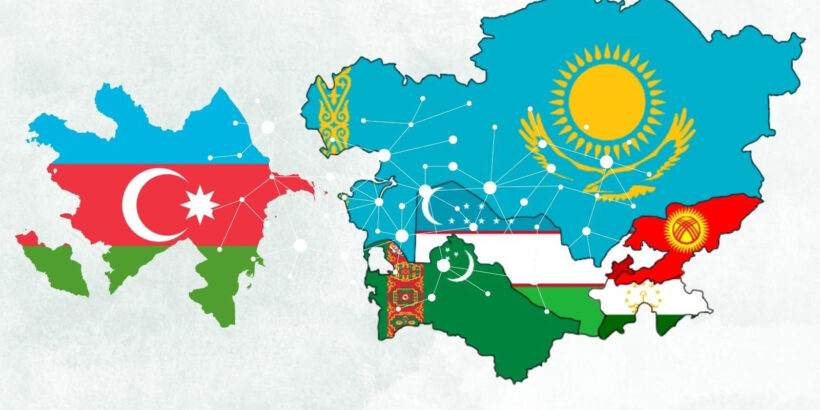
In recent years, Central Asia has assumed an increasingly important position in Azerbaijan’s foreign policy and economic agenda. The expansion of relations with Kazakhstan, Uzbekistan, Turkmenistan, Kyrgyzstan, and Tajikistan can no longer be viewed merely as the development of diplomatic ties. A broader and more long-term process is underway. The South Caucasus and Central Asia are becoming increasingly interconnected economic spaces through expanding transport, energy, trade, investment, and digital linkages. Azerbaijan’s role in this process is shaped not only by its favorable geographical position but also by the infrastructure projects and economic policies it has pursued in recent years.
A key feature of Azerbaijan’s growing engagement with Central Asia is the way in which political relations are increasingly complemented by concrete economic projects. One of the main pillars of this integration is the Middle Corridor, officially known as the Trans-Caspian International Transport Route. By connecting China and Central Asia through the Caspian Sea to Azerbaijan and subsequently to Europe via Georgia and Türkiye, the corridor is enhancing Azerbaijan’s significance within the international trading system. The geopolitical and logistical risks that have emerged along international trade routes in recent years have increased the importance of alternative routes, thereby strengthening the strategic relevance of the Middle Corridor.
For Azerbaijan, the significance of the Middle Corridor extends well beyond transit revenues. The Port of Baku, the Baku–Tbilisi–Kars railway, and other logistics infrastructure provide important opportunities for directing cargo flows from Central Asia toward European markets. The key challenge, however, is to combine the growth of transit volumes with activities that generate higher domestic value added. Logistics hubs, warehousing, digital services, industrial parks, and export-oriented manufacturing can all derive substantial benefits from the development of the corridor. In this regard, one of Azerbaijan’s major opportunities lies in moving beyond the conventional model of a transit country toward becoming a regional logistics and integration hub.
Cooperation with Azerbaijan is also becoming increasingly important for the Central Asian states. The lack of direct access to the world’s oceans for several countries in the region creates additional logistical challenges in reaching international markets. Azerbaijan, through the Caspian Sea, provides an important connection linking these countries with Türkiye and European markets. This creates a relationship based on mutual economic interests. Central Asian states gain opportunities to diversify their export routes, while Azerbaijan benefits from growing cargo flows, trade, investment, and associated economic activity.
The role of the Organization of Turkic States is also particularly significant in this process. The historical and cultural ties among Azerbaijan, Türkiye, Kazakhstan, Uzbekistan, and Kyrgyzstan are increasingly acquiring a stronger economic dimension. Azerbaijan’s close relations with Türkiye, its access to Central Asia across the Caspian Sea, and its transport and energy connections with European markets position the country as one of the principal geoeconomic hubs of the Turkic world. The expansion of cooperation in transport, energy, investment, customs, digitalization, and trade can further strengthen the economic potential of the broader Turkic space.
The recent dynamics in Azerbaijan’s relations with Kazakhstan and Uzbekistan further demonstrate the depth of this process. The elevation of bilateral relations to the level of allied relations has strengthened political trust while also creating a more favorable environment for economic cooperation and joint projects. The expansion of trilateral cooperation among Azerbaijan, Kazakhstan, and Uzbekistan can contribute to establishing more systematic economic links between Central Asia and the South Caucasus. Such cooperation may also facilitate the development of interconnected supply chains and infrastructure networks across the Caspian region.
Energy represents another major dimension of this integration. Azerbaijan has long played an important role in Europe’s energy security. In the new phase of regional cooperation, however, the scope of energy relations is expanding. Alongside traditional oil and natural gas projects, renewable energy and electricity transmission are becoming increasingly important areas of regional cooperation. Cooperation among Azerbaijan, Kazakhstan, and Uzbekistan in the field of green energy creates prospects for transmitting part of Central Asia’s considerable solar and wind energy potential through Azerbaijan toward European markets. This could strengthen Azerbaijan’s position not only as an energy exporter but also as a regional platform connecting different energy systems and markets.
This integration also creates new opportunities for Azerbaijan’s non-oil economy. There is significant potential to expand exports to Central Asian markets, increase mutual investment, establish joint ventures, and develop regional production and supply chains. Agriculture, food processing, logistics, tourism, information technology, and a wide range of service industries can benefit from deeper economic cooperation. The expansion of these sectors would also support Azerbaijan’s broader objective of diversifying its economic structure and increasing the contribution of non-oil activities to long-term growth.
From a broader perspective, Azerbaijan’s integration with Central Asia carries implications that extend beyond individual diplomatic initiatives. It represents a process of expanding Azerbaijan’s economic geography, strengthening the economic dimension of its relations with the Turkic world, and increasing its role in Eurasian trade. The Middle Corridor constitutes a major transport pillar of this integration, energy projects provide an important energy dimension, while the Organization of Turkic States offers a significant political and institutional framework for deeper cooperation.
The central challenge is now to translate political proximity into tangible economic outcomes. Increasing trade and investment, reducing logistics costs, integrating digital systems, and encouraging greater participation by the private sector in regional projects can significantly enhance the economic benefits Azerbaijan derives from this process. In this context, Azerbaijan’s future geoeconomic advantages will be determined not only by the natural and energy resources it possesses, but increasingly by its ability to connect regions, markets, infrastructure networks, and economic systems. This capacity may become one of the country’s most important strategic assets in the evolving economic architecture of Eurasia.

Ali Salimov, Ecomonist, Leading expert, Legal Analysis and Research Public Union