
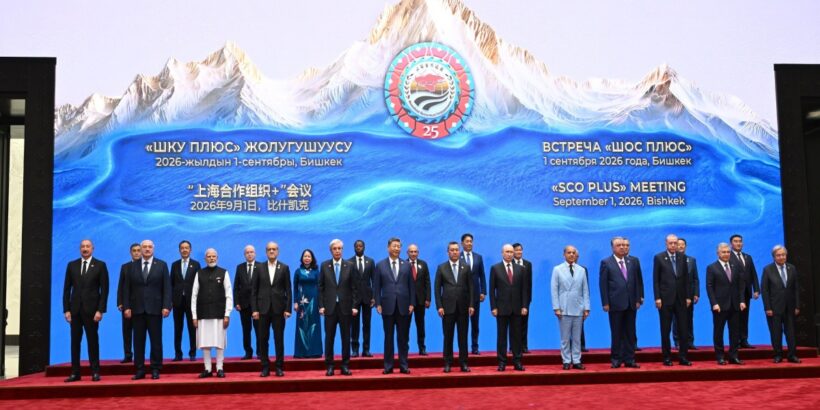
The working visit of President of the Republic of Azerbaijan Ilham Aliyev to Kyrgyzstan on August 31, 2026, is primarily associated with his participation in the events of the Shanghai Cooperation Organization (SCO). However, the political significance of this visit is not limited to the SCO agenda. Within the framework of Azerbaijan’s growing diplomatic and economic engagement in Central Asia, the meetings held in Bishkek are of considerable importance in terms of further strengthening the country’s position within one of Eurasia’s key geopolitical and geoeconomic platforms. The meeting with Armenian Prime Minister Nikol Pashinyan held during the President’s visit adds an additional strategic dimension to the agenda.
In recent years, the SCO has evolved from a regional platform focused primarily on security issues into an organization of broader significance in the fields of transportation, energy, trade, digital economy, and regional connectivity. The presence of major geopolitical and economic actors such as China, Russia, India, Iran, Pakistan, and the Central Asian states within and around the organization has transformed the SCO into one of the important centers shaping the future economic architecture of Eurasia.
Azerbaijan’s participation in this process is a logical continuation of the country’s transportation and energy policies developed in recent years, alongside its advantageous geographical position. Baku is no longer acting solely as an energy exporter located in the Caspian basin; it is increasingly emerging as a connectivity hub linking East and West, Central Asia with the South Caucasus, and these regions with Europe. The development of the Middle Corridor, the expansion of cargo transportation across the Caspian Sea, the enhancement of the capacities of the Port of Baku, and the elevation of Azerbaijan’s relations with Central Asian states to the level of strategic partnership constitute the principal elements of this approach.
President Ilham Aliyev’s visit to Bishkek should be regarded as an indication of a new stage in Azerbaijan’s approach toward Central Asia. In particular, following the steps taken during the President’s state visit to Kyrgyzstan in July toward developing relations between Azerbaijan and Kyrgyzstan at the level of allied partnership, his return to Bishkek at the end of August demonstrates the intensity of political dialogue between Baku and Bishkek. In his address on August 31, the President also emphasized that relations between Azerbaijan and Kyrgyzstan have already reached the level of allied partnership.
However, one of the most noteworthy aspects of the visit is the meeting between the President of Azerbaijan and the Prime Minister of Armenia. The fact that the meeting took place precisely in Bishkek, on the sidelines of the SCO events, demonstrates the changing nature of regional diplomacy. This sends an important political message that Azerbaijan-Armenia relations are no longer discussed exclusively through bilateral or Western platforms, but are also becoming part of the broader Eurasian diplomatic space.
Another important aspect of this meeting is that Azerbaijan, in its foreign policy, seeks to utilize parallel diplomatic channels rather than choosing between different geopolitical platforms. For Baku, the principal objective is not to consolidate its position within any particular geopolitical bloc, but rather to expand opportunities for multilateral cooperation that serve Azerbaijan’s national interests.
The SCO platform in Bishkek also creates important opportunities for Azerbaijan in this regard. The expansion of economic relations with China and Central Asia, the development of transportation corridors, energy security, and regional trade occupy an important place in Azerbaijan’s future economic strategy. Azerbaijan’s participation in SCO events provides additional diplomatic opportunities for establishing new partnerships in these areas.
It would therefore be inappropriate to assess President Ilham Aliyev’s visit merely as participation in another international event. The visit represents the convergence of several dimensions of Azerbaijan’s policy: strengthening its position in Central Asia, increasing its role in Eurasian transportation and economic connectivity, and continuing dialogue on relations with Armenia. The developments in Bishkek demonstrate that Azerbaijan’s regional policy is increasingly oriented toward the integration of the Central Asia–South Caucasus–Europe axis. This, in turn, creates significant opportunities for Azerbaijan to enhance its role not only in regional affairs but also in broader Eurasian geoeconomic processes in the coming years.

Ali Salimov
Researcher